Pages

Get Paid To Promote, Get Paid To Popup, Get Paid Display Banner
Showing posts with label Architecture Design Research. Show all posts

Friday, February 10, 2012

ROTOR

ROTOR - Rooftop Apartment, Copenhagen

ROTOR 1


ROTOR 2

ROTOR 3

ROTOR 4


J. MAYER H. Project Team: Jürgen Mayer H., Sebastian Finckh, Dominik Schwarzer, Jan Stockebrand, Guvenc Ozel

In collaboration with Jens Martin Skibstedt
2004 – 2006

Photographer: Stuart McIntire

A new protoprogrammatical penthouse, Rotor, is overlooking Copenhagen. The strategy of this urban apartment disolves traditional spaces and program. ROTOR is a space continuum which pulsates around a central twirling media column. Each of the four programmatic pockets of the semipublic areas is shaped along panoramic views onto the city context. The media column in the center incorporates various technological devices for entertainment, controll, information and communication. By rotation, these different media services blur fixed program into a dynamic space continuum. In combination with new media and technological effects to the domestic environment, extra sensorial elements like sound patterns and light pulsations balance the space between comfort and surprise.

Tuesday, January 24, 2012

LEE

LEE - ETH, Bürogebäude für Forschung und Lehre Neubau


J. MAYER H. Project Team: Juergen Mayer H, Paul Angelier, Alexander Arnold

International competition 2007
Client: ETH, Swiss Federal Institute of Technology Zurich, Swiss
Site: Leonhardstrasse, Zürich, Swiss

Six.Stack ist eine Addition klar strukturierter Volumen, die in Größe und Proportion den kleineren Nachbargebäuden entsprechen. Sie sind so gestapelt und gegeneinander verschoben, dass sie optimal in die Umgebung integrieren. Durch die Verschiebung entsteht in der Perspektive eine spannende Bereicherung der Straßenflucht. Auf Straßenniveau ist der Baukörper offen gestaltet, um die öffentlichen Funktionen nach außen sichtbar zu machen. Die Materialität der Fassade ist ebenfalls auf die angrenzende Bebauung abgestimmt. Der Glasfassade sind gliedernde Bänder aus Stein vorgelagert. Die Fassadenstruktur nimmt die im Straßenbild vorhandenen vertikalen und horizontalen Gliederungselemente auf und interpretiert sie so um, dass sie dem Gebäudemaßstab und der sich dahinter stattfindenden Funktion entsprechen. In den vertikal gegliederten Volumen sind doppelgeschossige Wintergärten vorgelagert, die eine erhöhte Aufenthaltsqualität für die dahinterliegenden Räume bieten und eine wichtige Funktion im Nachhaltigkeitskonzept übernehmen. Die horizontal gegliederten Volumen bieten Platz für lange Fensterbänder und somit einen großzügigen Panoramablick über die Stadt.

KKW

KKW - Kultur- und Kongresszentrum Würth, Künzelsau, Germany


J. MAYER H. Competition Team: Juergen Mayer H., Jan-Christoph Stockebrand, Simon Takasaki, Paul Angelier, Marcus Blum, Alessandra Raponi, Christoph Emenlauer

International Competition: 2006
Client: Adolf Würth GmbH & Co. KG

Structural Engineers: Krebs und Kiefer, Karlsruhe
Kitchen Engineers: Martin Scherer, Darmstadt
Landscape Architect: Klaus Wiederkehr, Nürtingen
Building Physics: Nek Ingenieur Gruppe GmbH, Berlin
Museum consultant: Andres Lepik, Berlin

Mit dem Kultur- und Kongresszentrum Würth in Künzelsau wird ein vitaler Produktionsort ein besonderes Zentrum mit großer Ausstrahlung und hoher Anziehungskraft zu verwandeln. Durch die Platzierung eines vierflügeligen Solitärs an der höchsten Stelle des Grundstücks, der sich aus der Landschaft entwickelt, entstehen vielfältige Ausblicke in die Umgebung. Die Mischungsnutzung aus Veranstaltungsräumlichkeiten, Museum, Kongressbereich, Bibliothek und Gastronomie ermöglicht ganzjährig eine lebendige kulturelle Öffentlichkeit und schafft einen neuen Ort im Verbund von Landschaft und Architektur. Nach dem Prinzip Hülle-Zentrum liegt in allen vier Gebäudearmen jeweils ein Kern im Inneren des Volumens, um den herum sich die zugehörigen Funktionen legen. Durch die sich öffnende Gebäudeform können Zugänge und Anlieferungen direkt und problemlos erfolgen. Die Übersichtlichkeit ist dabei von grosser Wichtigkeit. Die internen Erschließungen setzen das Motiv der Landschaft ins Innere fort. Die Fassaden hüllen diese klare funktionale Raumorganisation ein. Analog zur größten Öffentlichkeit im EG und Zentrum des Gebäudevolumens verändern sich die Fassaden stufenweise mit abnehmender Transparenz von unten nach oben. Dabei ist in jedem Bereich der Ausblick ein wichtiger Aspekt, um das Gebäude im Kontext zu verankern. Die gekrümmten Flächen des Volumens versetzen den Gebäudekörper in eine dynamische Spannung und fassen damit gleichzeitig den Außenraum. Das Kultur- und Kongresszentrum Würth reflektiert die unterschiedlichen Lichtsituationen während des Tages. Bei Nacht strahlt es eine elegante Feierlichkeit aus.

The Würth Cultural and Conference Centre in Künzelsau is to transform an existing dynamic site of production into a lively, pivotal centre with charisma and destination appeal. The stand alone building, comprised of four separate wings joined at the centre, is situated on the highest point of the site, growing out of the landscape and commanding unparalleled views over the surrounding countryside. A vibrant, year round, mixed-use composition of performance spaces, museum, conference facilities, library and hospitality spaces creates a new venue where landscape and architecture can unite. According to the shell/centre principle, each of the four wings of the building contains a core at the inner part of the volume, around which the relevant functions are distributed. Access and delivery are made easy and clear by the radial plan of the building, whilst internal circulation brings the landscape into the interior. The functionally organized spatial planning is enveloped by the facades. The free, open nature of the ground floor and the central part of the building is reflected in the facades, which start out transparently, and become increasingly opaque as they reach upward. However, the view to the landscape is an important aspect of every part of the structure, grounding the building within the site. The curved surfaces that comprise the building’s volume create a dynamic tension within the body of the building while simultaneously framing the exterior. The Würth Cultural and Conference Centre reflects the different natural lighting situations of the daylight hours, at night the building glows with a festive elegance.

KERYKES

KERYKES - Urban Activity Generator


Ephemeral Structures Cultural Oympiad
Athens 2004

Int. Competition 2003
Honourable Mention


KERYKES are multifunctional platforms which generate a broad variety of programs and events. In peripheral areas, where shopping, production and living miss a cultural institution or social space, KERYKES offer a new location as a meeting place for local citizens and visitors of the Olympic Games. These event structures have a daily rhythm that adjusts to everyday patterns like shopping and commuting as well as to special events and leisure activities. With KERYKES as activity generators, community activity and tourist events melt into one special moment of interaction. KERYKES are unprogrammed structures which provoke all different kinds of activity. Internet cafes, daytime sleeping areas, exhibitions and consulting offices might be a possible addition to the shopping and commuting ritual. Fun sports, open air movies and theaters add another layer of attraction onto this part of the city. KERYKES are adressing the people of Athens to realize certain events for a limited time. One or more structures can be placed next to each other. Each KERYX can be rotated to serve different needs. In combination with each other a complex set of an activity landscape offer highly differentiated spaces.

Sunday, January 22, 2012

DESERT.ROSE

DESERT.ROSE


J. MAYER H. Competition Team: Mehrdad Mashaie, Simon Kassner, Max Reinhardt

XI ThyssenKrupp Elevator Award, Dubai ’0 2008
Tall Emblem Structure, Za’abeel Park, Dubai (UAE)

Structural engineering: Eisenloffel.Sattler + Partner, Berlin
Consulting engineer: Prof. Karen Eisenloffel, M.Sc.

Za’abeel Park is known as a recreational part of Dubai, containing exhibition program focused on technology, sports facilities and restaurants. Anticipating on this mixed-use urban landscape, the addition of other public program enhances the overall experience. The tower designed for the XI Thyssen Krupp award, consist of a compact cluster of egg-shape volumes, bubbling up towards the sky and offering views of the different scenarios of the city of Dubai.

Saturday, January 21, 2012

CIVI CENTRE MESTIA

CIVI CENTRE MESTIA, Georgia


J. MAYER H. Architects 
Project Team: Juergen Mayer H., Jesko Malkolm Johnsson-Zahn, Danny te Kloese

Design Study: 2010
Client: Ministry of Justice of Georgia

CIVIC CENTRE GORI

CIVIC CENTRE GORI, Georgia


CIVIC CENTRE GORI


Design Study: 2010
Client: Ministry of Justice of Georgia

J. MAYER H. Architects
Project Team: Juergen Mayer H., Hugo Reis, Max Reinhardt, Jesko Malkolm Johnsson-Zahn

Friday, January 20, 2012

STADTHAUS MARKTPLATZ


Int. Wettbewerb 1998, 1. Preis
Fertigstellung: 2002
Bauherr: Stadt Ostfildern
Projektleitung: Andre Santer, Sebastian Finckh
Kontaktarchitekten: Architekturbüro Uli Wiesler (Stuttgart), Klaus Wiederkehr (Landschaftsplanung, Nürtingen)

Collection of MoMA New York, USA

Siehe auch Pitterpatterns und wind.light

Im Zentrum des Scharnhauser Parks liegt der Marktplatz mit dem “stadt.haus”, ein multifunktionales öffentliches Gebäude, das Stadtverwaltung, Bürgerservice, Stadtteilbibliothek, Städtische Galerie, Musikschule, Trauzimmer, Volkshochschule, Büroräume und einen Festsaal unter einem Dach zusammenfasst. Das gesamte Haus ist als ein großer öffentlicher Raum konzipiert, in den einzelne Funktionen für bestimmte Anforderungen als Kernräume eingelegt sind. Um sie herum legt sich ein fließender Kommunikationsraum für zufällige oder geplante Begegnungen. Vom Marktplatz bis zum begehbaren Panoramadach verbindet sich das Stadthaus durch Einschnitte und Terrassen mit dem Außenraum. Diese Einschnitte bleiben als strategische Erweiterung des Raumprogramms über die üblichen Öffnungszeiten hinaus aktiver öffentlicher Raum. Sie werden durch Licht- und Wasserelemente animiert und setzen Natur und Technologie in ein wechselseitiges Abhängigkeitsverhältnis. Von der leuchtenden Unterseite des Vordachs tropft ein computergesteuerter künstlicher Regen, durch den man zum Eingang gelangt. Mit Stadthaus und Marktplatz wurde ein Prototyp entwickelt, der exemplarisch die Gleichzeitigkeit des städtischen Lebens im realen, medialen und virtuellen öffentlichen Raum umsetzt.

stadthaus is located at the center of Scharnhauser Park, a former American military site next to Stuttgart airport. It is a multifunctional public building unifying municipal administration, civic services, a public library, an art gallery, classrooms for music lessons and evening school, a wedding room, office space, sports facilities and a multipurpose hall. This combination of different public services generates synergetic effects provoking programmatic and visual transparency. Spatially the entire building is considered as large, open public space with inlays of certain core elements. Floating within a space for mutual or strategic communication, these enclosed boxes structure the interior layout of the building. From the main square to the panorama deck on the roof, the stadthaus interlocks with its context through cutouts and terraces. These open air spaces remain accessible beyond the main opening hours and therefore serve as spatial and programmatic extensions. Light and water animations are an integral part of the stadthaus and include a subtle relationship between nature and technology. Framing the main entrance visitors will have to walk through a computer animated artificial rain dripping from underneath the flat cantilevered roof. Wind.light is a light installation next to the stadthaus. The stadthaus and square construct a new public building prototype by offering simultaneity of city life in real, mediated and virtual space.

SONNENHOF Jena

SONNENHOF Jena


SONNENHOF Jena

J. MAYER H. Project Team: Juergen Mayer H., Jan-Christoph Stockebrand, Christoph Emenlauer, Jens Seiffert, Max Reinhard, Christian Pälmke

Project: 2008-2011
Client: Wohnungsgenossenschaft “Carl Zeiss” eG

Projektsteuerung / Bauleitung: Kappes Partner IPG, Berlin
Architekt Altbau: Rittmansperger + Partner, Erfurt
Brandschutz / Statik: Ingenieurbüro Dr. Krämer GmbH, Weimar
TGA: Scholze Ingenieurgesellschaft mbH, Dresden
Bauphysik: Ingenieurbüro Santer Bauphysik, Duisburg
Lüftungsgutachter: Ingenieurbüro Rau, Heilbronn
Verkehrsgutacher: GRI Ingenieure, Berlin

Modellbau: Werk 5, Berlin

Der Sonnenhof besteht aus vier neuen Gebäuden mit Büro- und Wohneinheiten. Diese befinden sich auf einem aus mehreren Parzellen zusammengelegtem Grundstück im historischen Zentrum von Jena. Die geplanten einzelnen Baukörper, erlauben eine freie Durchwegung des Geländes. Durch ihre Platzierung an den äußeren Grundstücksgrenzen definieren sie einen der mittelalterlichen Stadtstruktur entsprechenden kleinmaßstäblichen Freiraum. Die Außenanlagen führen das Gestaltungskonzept der Gebäude über die Grundstücksgrenzen hinaus fort. Die geplante Verbindung aus Gewerbe, Wohnen und Büro ermöglicht eine kleinteilige und flexible Nutzungsstruktur und gliedert sich auch inhaltlich in das Umfeld ein.

Sonnenhof consists of four new buildings with office and residential spaces. Located on a consolidated number of smaller lots in the historical center of Jena, Germany, the separate structures allow for free access through the grounds. Their placement on the outer edges of the plot defines a small-scale outdoor space congruent with the medieval city structure. Its outdoor facilities continue the building’s overall design concept past the edges of the lot. The planned incorporation of commerce, residence and office enables a small-sectioned and flexible pattern of use that also integrates itself conceptually into the surroundings.

Office Complex Steckelhörn

S11 - Office Complex Steckelhörn 11, Hamburg

S11


S11

S11

S11


J. MAYER H. Project Team: Juergen Mayer H., Hans Schneider, Wilko Hoffmann, Marcus Blum

Project: 2007-2009
Completion: 2009
Client: Cogiton Projekt Altstadt GmbH, Hamburg

Architect on Site: Imhotep, Donachie und Blomeyer with Dirk Reinisch, Berlin
Structural Engineers: WTM, Hamburg
Building Services: Energiehaus with Sineplan, Hamburg
Model: Werk5, Berlin
Photographer: David Franck, photo@davidfranck.de

Das Projekt Steckelhörn 11 befindet sich zwischen dem kommerziellen Zentrum und der neuen Hafen City im ältesten Teil der Altstadt von Hamburg. Das Grundstück durchsticht den Block zur Straße Katharinenfleet, an dem sich das neue Gebäude mit einer schmalen Fassade von ca. 1,9 m präsentiert. Wie eine Flüssigkeit gleiten an der massiven Gebäudeform mit Keramikverkleidung vertikale Fensterbänder an den Fassaden herunter. Die Straßenfassade nimmt die Gestaltung und die Höhenentwicklung die Nachbargebäude auf. Durch Auskragungen der Fassade an der Straßenseite, sowie an der schmalen Fassade zum Katarinenfleet entstehen besondere räumliche Qualitäten. Durch eine Auskragung der schmalen Fassade zum Katherinenfleet und die besondere Höhenentwicklung wird das Gebäude von den Brücken zur Hafen City aus präsent und ein besonderer Teil der Skyline der Altstadt. Die besondere Grundrissgeometrie lässt ein spannendes Gebäude entstehen, das sich mit dem Eingang und der Lobby zur Straße Steckelhörn und mit der schmalen Fassade zur Speicherstadt und zur Hafen City präsentiert.

The project “Steckelhörn 11” is located in the old centre of Hamburg, close to the prominent new “Hafen City” development. It replaces a ruinous building and fills the gap between two historic premises. The triangular-shaped lot stretches across the city block, thus allowing for a narrow façade of about 1.3 m width facing the harbor and a main elevation of about 26.4 m oriented toward Steckelhörn street. The vertical design and soft setbacks of the latter pay tribute to the massing of the surrounding structures, as well as to local building-height regulations. Cantilevered elements in the main facade create a series of specific spatial qualities on the inside and outside. The top floors provide additional outside space, offering a spectacular panoramic view over the city of Hamburg. The particular geometry of the floor plan is the basis for the organization of the building, which architecturally and programmatically presents itself openly to Steckelhoern street while at the same time forming a characteristic landmark when perceived from the historic “Speicherstadt” and new “Hafen City”. As the ground level is conceived either as a spacious lobby for the main tenant or a public cafe, the upper floors provide for generous, flexible office space, most of it allowing a view of the “Katharinenkirche” and/or the “Hafen City”. The top floors provide additional outside space on balconies/loggias and a roof terrace, offering a spectacular panoramic view over the old and new city of Hamburg.

TERRA KARAVANA

TERRA KARAVANA


Rhike Kulturpark in Tiflis, Georgien

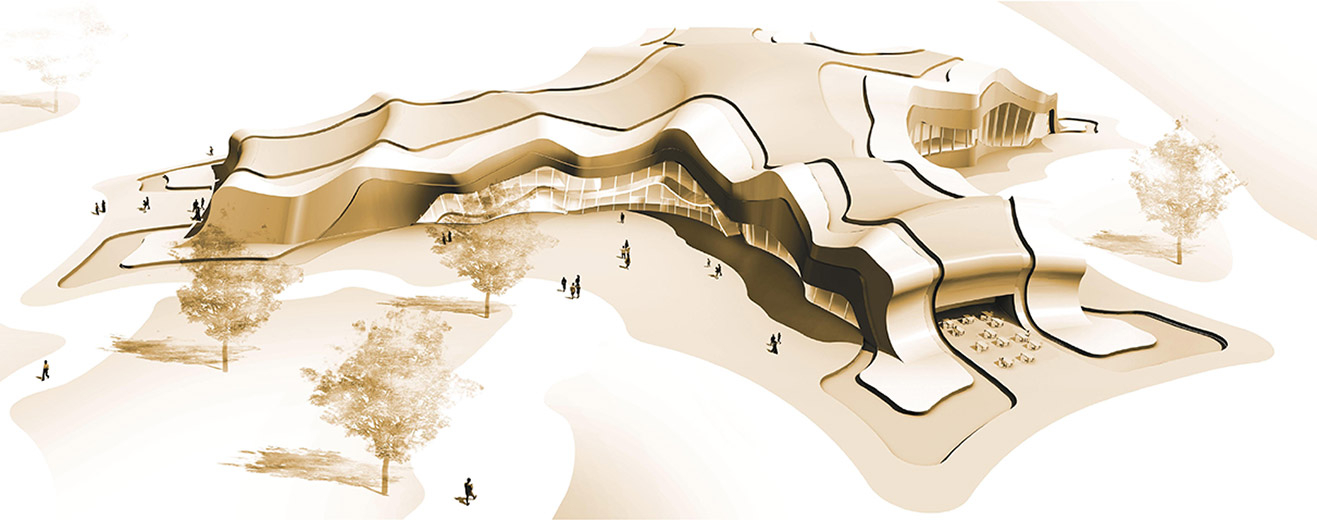
Terra Karavana ist eine moderne neue urbane Landschaft am Fluss im Herzen von Tiflis. Unter Bezugnahme auf die alte Karawanserei vor Ort, schafft das kulturelle Zentrum einer neuen Dynamik Identität für die Rhike Park. Der von allen Seiten zugängliche öffentliche Platz bildet ein lebendiges urbanes Zentrum im Freien. Es kombiniert Grünflächen und öffentliche Gebäude, darunter ein Mehrzweck-Veranstaltungshalle, ein Kino, ein Museum, ein Panorama-Restaurant und Geschäfte. Wasserspiele, Rasenplätze, Skulpturen und Lichtinstallationen aktivieren den gesamten Park und laden die Menschen in Tiflis und Besucher Tag und Nacht ein, um den Panoramablick über die Stadt und die umliegenden Berge zu genießen. Parallele Streifen dynamisieren das Gebiet entlang des Flusses. Die Modulation des Geländes bietet eine abwechslungsreiche Topographie und mögliche Standorte für die Aktivierung des Programms. Ein sanfter welliger Gehweg bildet eine Verbindung zwischen Park und oberem Teil der Stadt und ermöglicht Interaktionen auf verschiedenen Ebenen mit dem Kulturzentrum. Mehrzweckhalle, Kino und Museum sind in einem Komplex vereint deren wichtigsten Funktionen sich auf einer geschützten erhöhten Terrasse treffen. Das Restaurant in der obersten Etage bietet einen atemberaubenden Panoramablick über den Park und die Stadt Tiflis. Geschäfte im Erdgeschoss öffnen sich in die Landschaft und sind dem Fluss zugewandt. Kleine Hügel und Wellen im Park sind für Integration von Brunnen und Kiosken geeignet. Terra Karavana bietet eine moderne Identität im Kontext der Rhike Park.

Terra Karavana is a contemporary new urban landscape located on the riverfront in the very heart of Tbilisi. Referring to the old caravanserai on site, the cultural center creates a new dynamic identity for the Rhike Park. Access from all sides make this public outdoor space a lively urban center that combines green space and public buildings including a multipurpose event hall, a movie center, a museum, a panorama restaurant and shops. Water fountains, grass fields, sculptures and light installations activate the overall park and invite the people of Tbilisi and visitors day and night to enjoy the panoramic view over the city and its surrounding mountains. Parallel stripes create a dynamic field along the river. Modulations of the ground offer diversified topographies and possible locations for activating program. A gentle undulating walkway creates a connection between the park and upper part of the city while allowing interactions with the building at different levels. The multipurpose hall, the movie center and the museum are combined in one complex. The main functions meet on a protected elevated terrace. The restaurant on the top floor offers a stunning panoramic view over the park and the city of Tbilisi. Shops on the ground floor open up towards the river. The small hills and undulations in the park will provide for fountains and kiosks. Terra Karavana offers a contextualized modern identity for the Rhike Park.

MESTIA AIRPORT

MESTIA AIRPORT - New Airport Building in Mestia, Georgia


J. MAYER H. Project Team: Juergen Mayer H., Jesko Malkolm Johnsson-Zahn, Hugo Reis, Mehrdad Mashaie, Max Reinhardt

Project: October-December 2010
Completion: December 2010
Client: Tbilisi International Airport

Architect on Site: Beka Pkhakadze
Construction: ANAGI

Photographs: J. MAYER H.

Total Floor Area: 250 sq.m.

Der neue Flughafen in Mestia, Georgien ist Teil der ambitionierten Pläne die Region touristisch zu erschliessen. Die mittelalterliche Stadt, geprägt durch steinerne Wehrtürme, steht auf der Liste des UNESCO Weltkulturerbes und ist mittlerweile auch bekannt als Wintersportregion. Das Gebäude wurde in nur 3 Monaten geplant und realisiert. Der Flughafen wurde am 24. Dezember 2010 in Betrieb genommen.

The new built airport is part of Georgia’s ambitious plans to develop tourism in Mestia. The beautiful medieval town with its stone defensive towers is part of UNESCO’s list of World Heritage Sites and also famous as ski-resort. With the unveiling of the airport on December 24th the building was designed and constructed within 3 months.

MENSA

MENSA - Fachhochschule, Pädagogische Hochschule und Kunstakademie Karlsruhe


J. MAYER H. Project Team:
Jürgen Mayer H., Andre Santer, Sebastian Finckh, Julia Neitzel, Wilko Hoffmann, Jan Stockebrand, Marcus Blum
Mit: ARUP (Berlin), Martin Scherer (Gastronomieplanung, Darmstadt), Uli Wiesler (Freier Architekt, Stuttgart), Klaus Wiederkehr (Landschaftsarchitekt, Nürtingen)
Ausschreibung / Bauleitung: Architekturbüro Uli Wiesler, Stuttgart

Int. Wettbewerb 2004 1. Preis
Realisierung: 2006

Bauherr: Land Baden-Württemberg, Vertreten durch das staatliche Vermögens- und Hochbauamt, Karlsruhe

Fotos: David Franck

Mensa Karlsruhe is an elastic space, that sits in the center of the Karlsruhe University Campus. As an extension of the already existing facilites, the city of Karlsruhe is building a canteen that will serve the growing number of students. The building becomes the new adress of the campus, negotiating between the identities of three universities as well as between the urban fabric and the Hardtwad forest. The building reacts to this special condition with different stages of porosity.
 
© 2010 mbekutuk | Blogger.com